In June 2026, I launched my first app on the Apple App Store.
By October, I had reached my first 100 downloads!
Now, I know 100 downloads might not sound like a lot to some people, but to me, it was a HUGE milestone. I built something from an idea, put it out into the world, and 100 people downloaded it. That's pretty cool!
And the best part? I spent $0 on paid advertising.
I didn't have a big marketing budget, a team, or some elaborate launch strategy. I'm a solo developer who was learning a lot of this as I went.
So I wanted to share five things I did and learned while working toward my first 100 app downloads, and what I'd recommend if you're thinking about launching your own app.
1. I launched a simple MVP instead of waiting for the perfect app
If you've followed my journey, you know that I built Side Quest Slayer, an app that helps you document your progress toward your goals through photos and reflections.
The idea is simple: instead of only celebrating when you accomplish a goal, celebrate the little moments that get you there.
But when I first started brainstorming the app, I had SO many ideas.
AI features. Audio. Video. All kinds of things!
And those are still ideas I can explore in the future, but I decided to keep my first version simple.
You could create a quest, add photos of your progress, write a reflection, and look back at your journey.
That was enough to launch.
And I'm so glad I did because there were things I could only learn after putting the app into people's hands.
I also made the decision to launch on iOS first instead of trying to release on iOS and Android simultaneously. As a solo founder, focusing on one platform gave me room to learn, improve the experience, and figure out whether this was something I genuinely wanted to continue building.
Spoiler alert: it is!
My tip: You don't need every feature you've ever imagined before you launch. Start with the smallest version that delivers real value, and build from there.
2. I learned how to design an app by studying other apps
Okay, this was a BIG learning experience for me.
I have a computer science degree and previously worked as a software engineer, but that doesn't automatically mean I know how to design a beautiful app!
And when I look back at the first version of Side Quest Slayer, the difference is honestly pretty crazy.
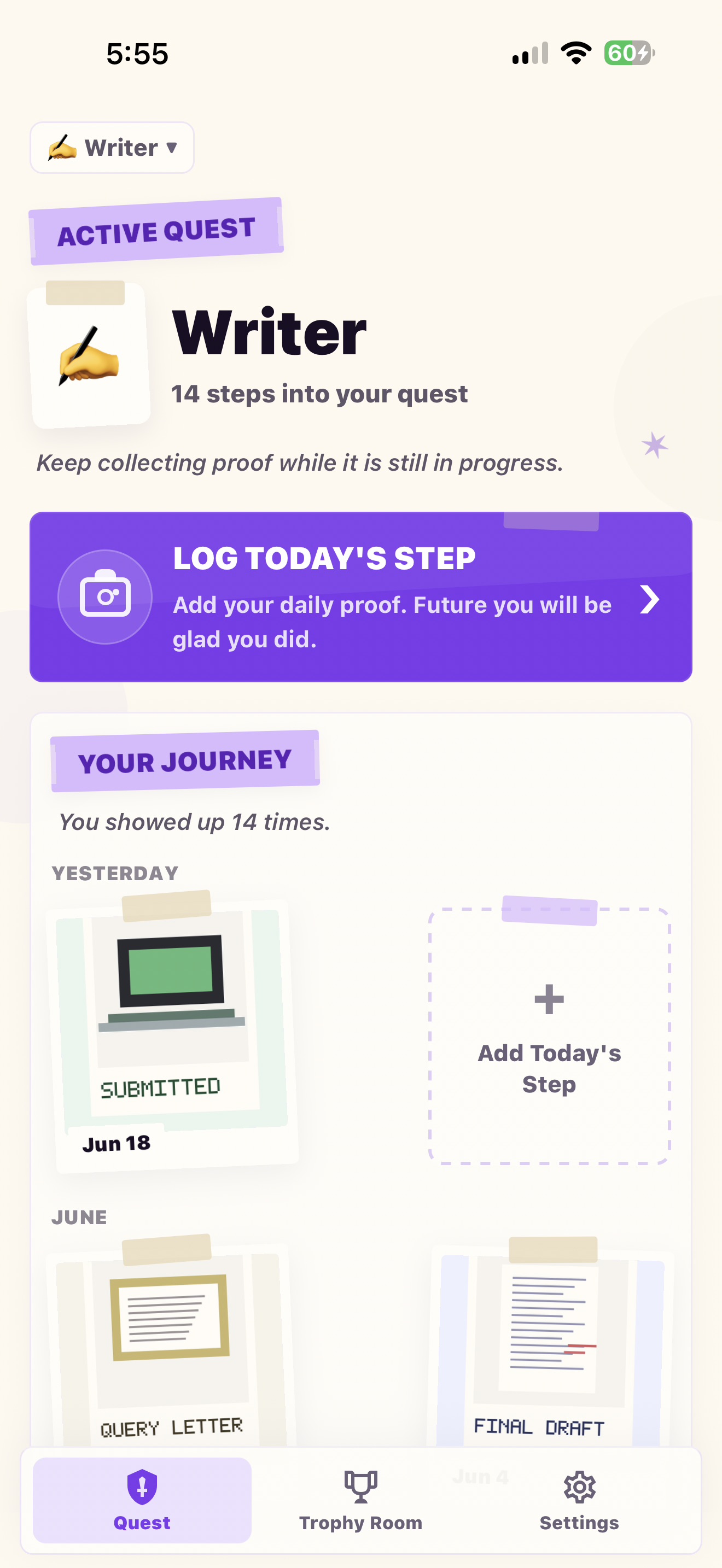
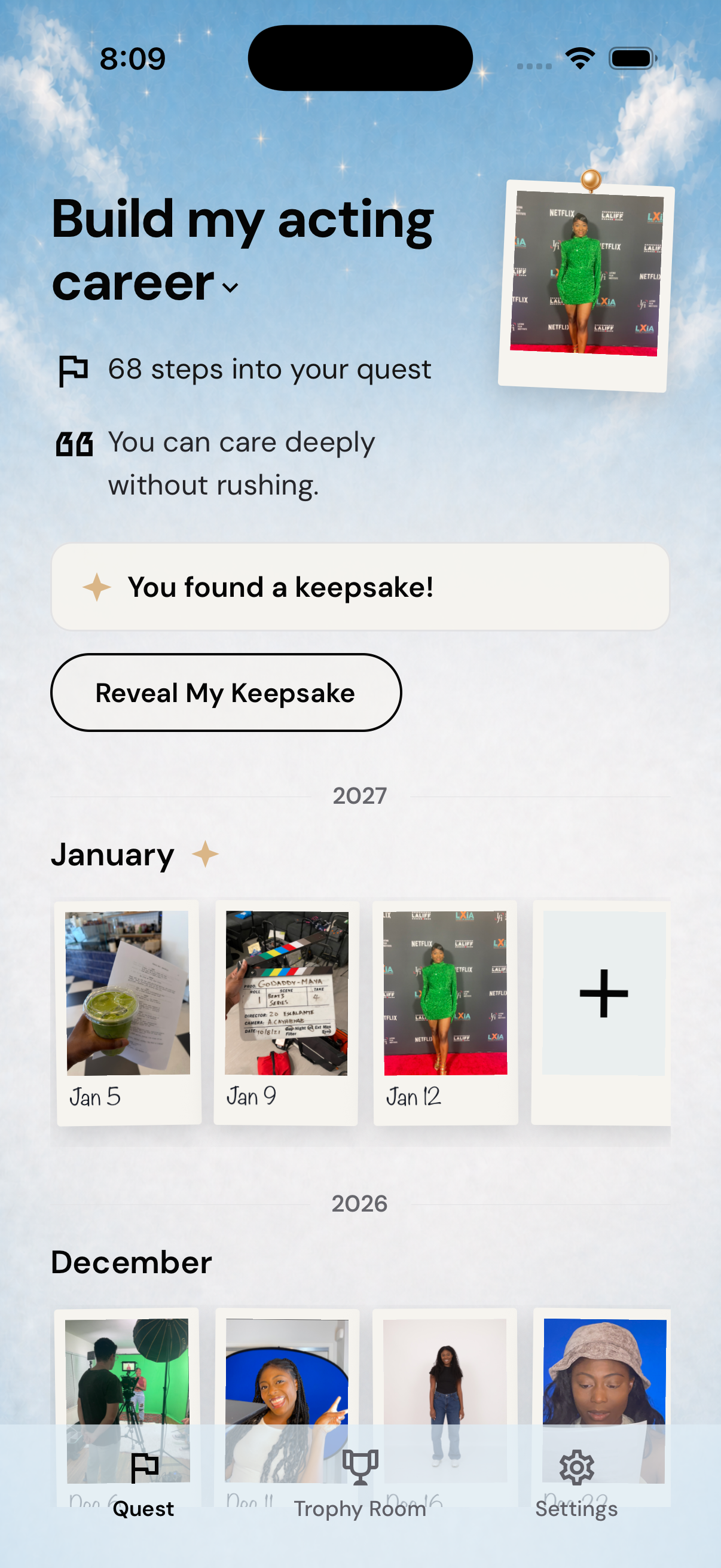
The original design was very purple, and while it worked, it wasn't quite the experience I wanted to create.
So I started doing research.
I discovered tools like Mobbin and Dribbble, where you can explore app interfaces, design patterns, and inspiration from other designers.
But I also started paying closer attention to apps I already had downloaded on my phone.
For example, smaller apps like Waterllama and I Am.
I thought about why I had downloaded those apps in the first place. Something about their presentation made me interested enough to try them.
So I looked at their designs, their App Store screenshots, and how they communicated what their apps actually did.
I also studied larger apps like Instagram and TikTok.
How do they handle navigation? How do they organize information? What happens when you tap something? How do they make certain features feel intuitive?
I wasn't trying to copy any one app. I was trying to understand what made a good user experience.
And after doing that research, I started making more intentional design decisions for Side Quest Slayer.
My tip: You don't have to invent every design pattern yourself. Study apps you genuinely enjoy using, understand why their designs work, and document your own design decisions so your product stays consistent.
3. I challenged myself to promote my app for 30 days
This might be my favorite thing I did.
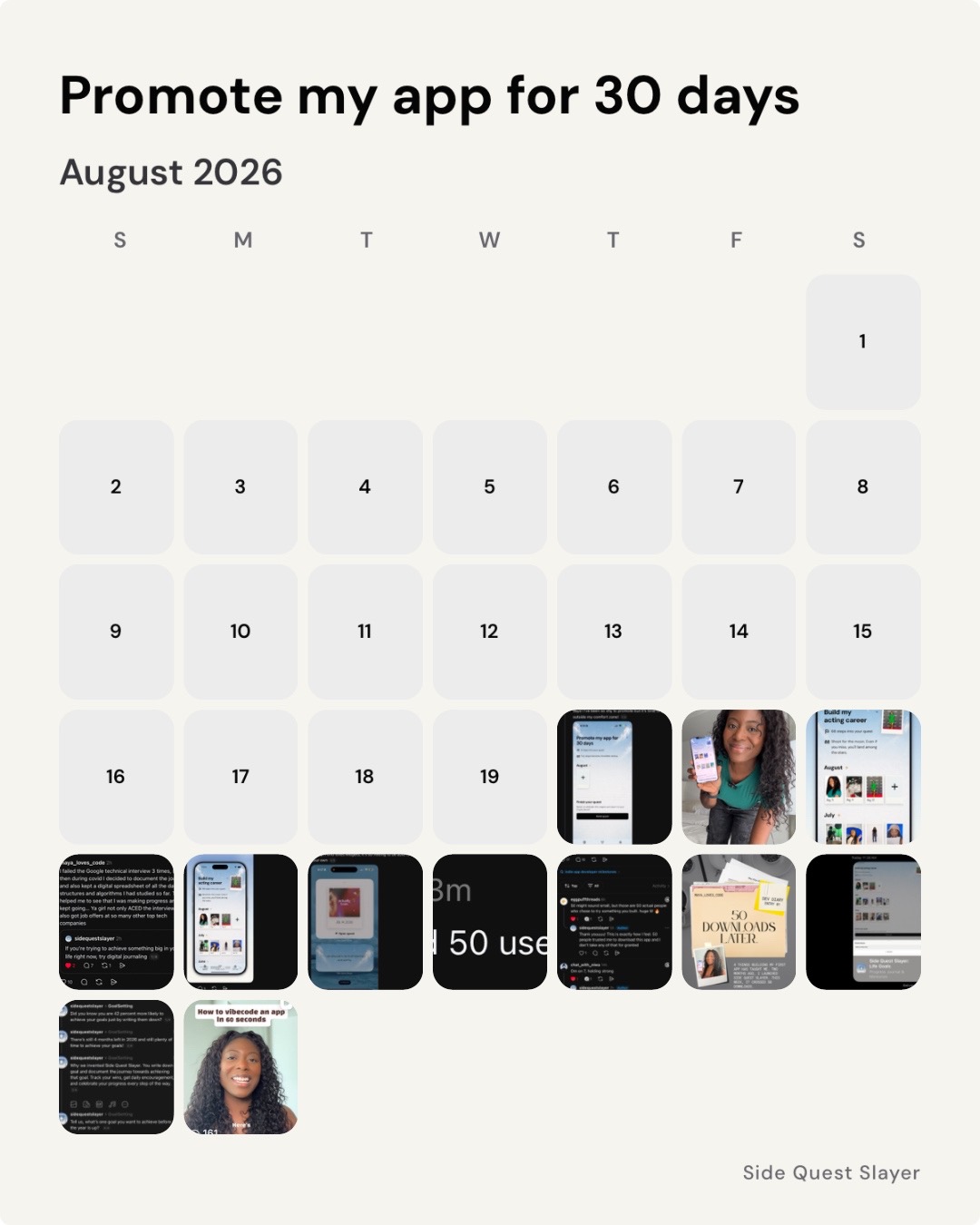
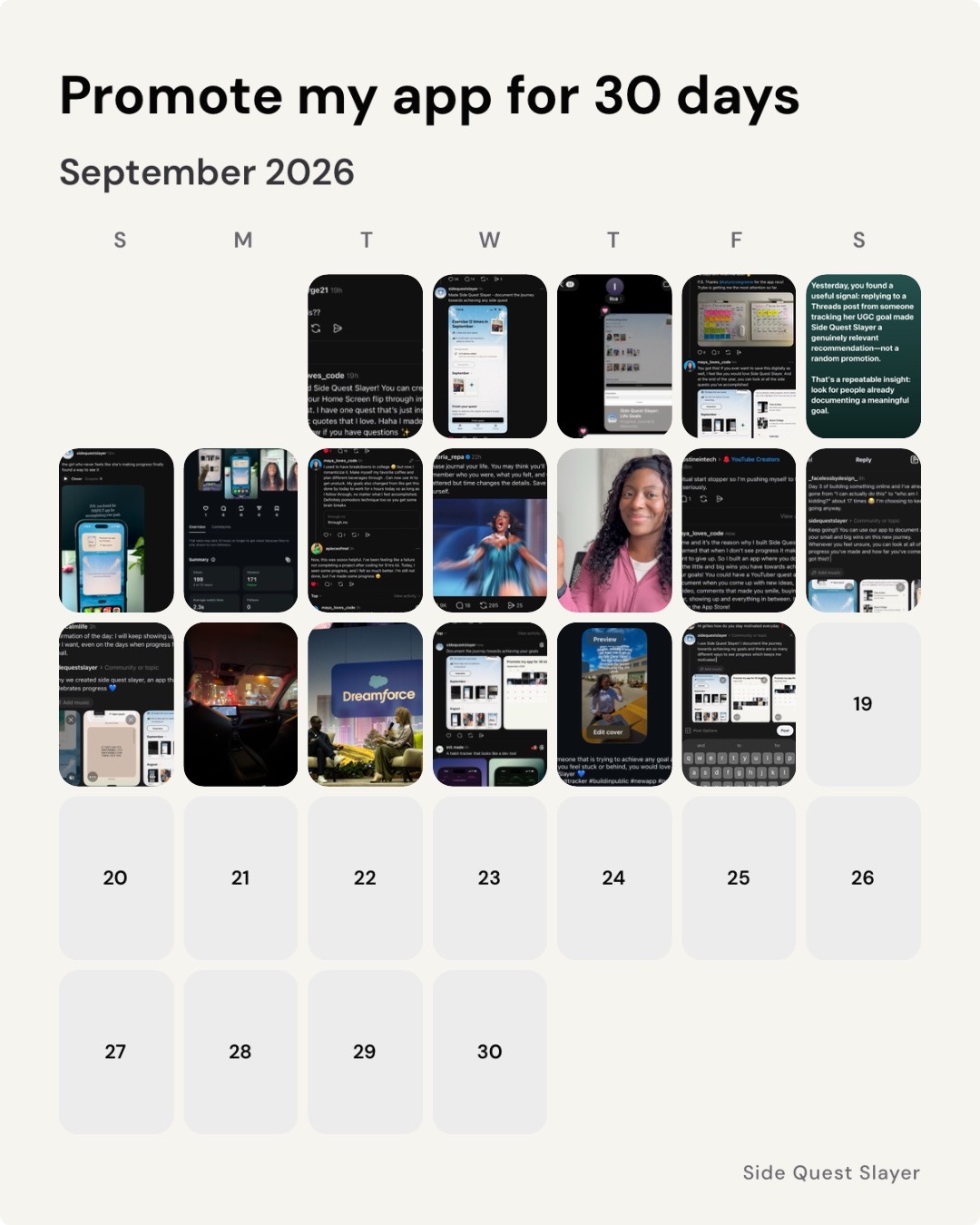
From August into September, I challenged myself to promote Side Quest Slayer for 30 days.
Thirty days of intentionally putting my app out into the world.
And honestly, one of the biggest things I gained wasn't even a download.
It was confidence.
At first, promoting the app felt like something I had to consciously remind myself to do.
I'd make a post, share it, and feel like, okay, I did it!
But by the end of the challenge, something had changed.
I became so much more comfortable talking about my app.
I noticed it recently when I was on Threads promoting one of my YouTube videos. I saw a post where it made sense to mention Side Quest Slayer, and I was about to comment about it without even thinking twice.
Promoting my app had started to feel natural!
And that's something I don't think I would have learned just by watching marketing tutorials or reading articles.
I had to actually do it.
The challenge also helped me experiment with different ways of sharing the app instead of relying on one announcement and hoping people would remember it existed.
I loved the experience so much that I could absolutely see myself doing another 30-day marketing challenge.
My tip: If promoting your product feels uncomfortable, give yourself a challenge. You don't need to go viral every day. The goal is to build the habit of showing up.
4. I started learning App Store Optimization (ASO)
Before launching my app, I was much more familiar with building software than marketing software.
One thing I started learning about was App Store Optimization, or ASO.
Think of it like SEO, but for the App Store.
When someone searches for an app, how does Apple decide what to show them? What keywords are people searching for? How competitive are those keywords? Does your app's title clearly communicate what it does?
These were questions I started exploring as I worked on growing Side Quest Slayer.
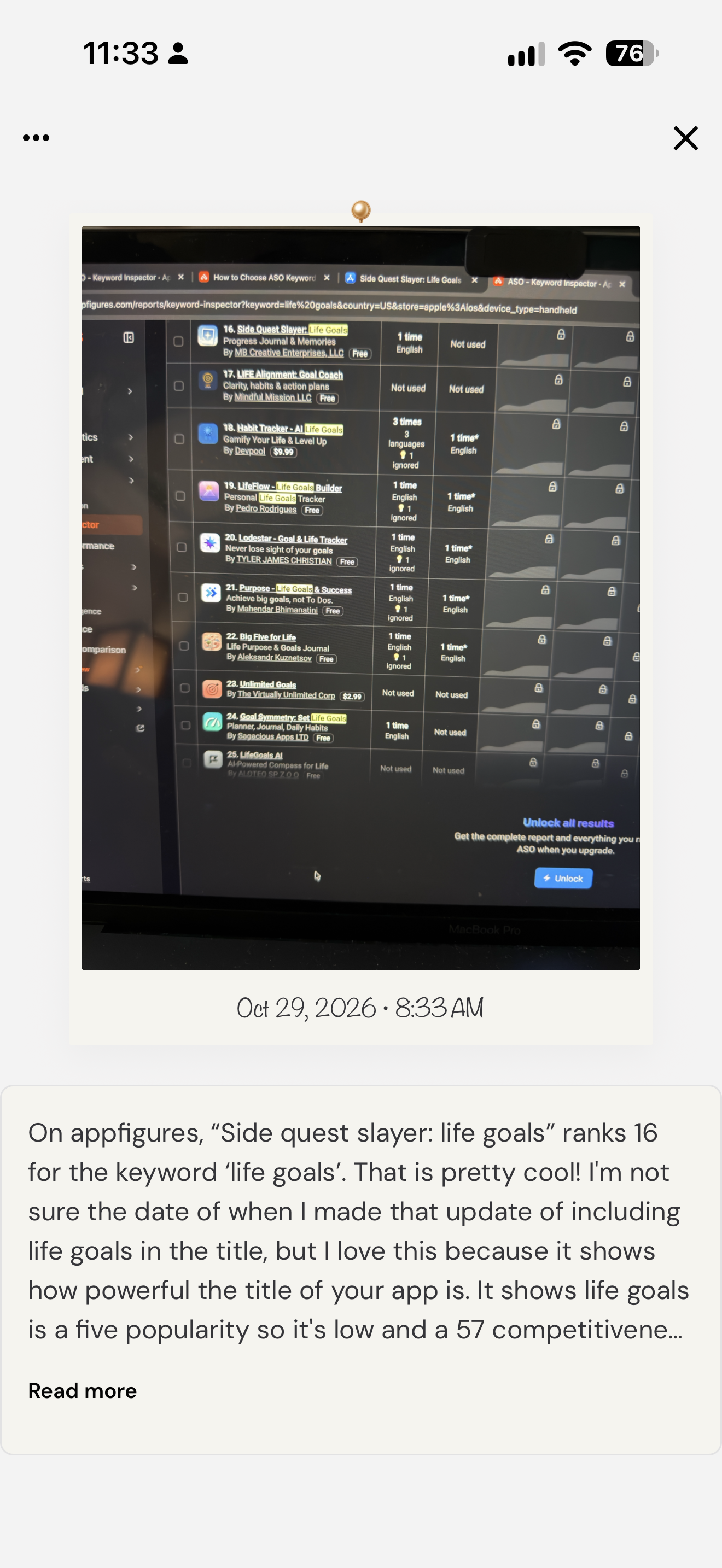
One thing I discovered was that Side Quest Slayer was ranking #16 for the keyword "life goals."
I thought that was so cool!
But then I did more research and realized that "life goals" had relatively low search popularity.
Meanwhile, a keyword like "goal tracker" had much higher search popularity, but also more competition.
That made me think differently about how I describe my app.
Instead of only thinking about what sounds creative or catchy, I started thinking about the words people actually use when they're looking for an app like mine.
Now, I want to be clear: I was still learning ASO when I reached my first 100 downloads. I'm not claiming that an ASO change magically got me there.
But reaching that milestone made me even more interested in learning how to help new people discover the app organically.
My tip: Don't overlook the App Store itself as a discovery channel. Research how people search for apps like yours, and use those insights to improve your listing. You don't need to know everything before you start learning.
5. I tracked my progress and celebrated the little wins
Okay, this one might sound obvious coming from the person who built a progress-tracking app, but hear me out!
When I launched Side Quest Slayer in June, I got 12 downloads.
In July, I got 19.
In August, 31.
In September, 32.
In October, I got 70—bringing the total to 164 downloads and passing that first 100-download milestone!
| Month | Downloads |
|---|---|
| June | 12 |
| July | 19 |
| August | 31 |
| September | 32 |
| October | 70 |
| Cumulative after October | 164 |
Looking at those numbers, it's easy to think, "Only 12 downloads?"
But those were 12 more than I had before.
And each month, I was learning something new.
One of my favorite books is The Gap and the Gain, which talks about the importance of measuring your progress against where you started instead of constantly measuring yourself against an ideal you haven't reached yet.
That mindset has been incredibly helpful throughout this journey.
Instead of thinking, "I only have 100 downloads," I can think, "I launched an app that didn't exist a few months ago, and now 100 people have downloaded it!"
That's a completely different way to experience the same accomplishment.
And it's honestly one of the reasons I love using Side Quest Slayer myself.
I get to look back at the photos, milestones, and little moments that remind me how far I've come.
My tip: Track more than just your final results. Document the experiments, improvements, and small milestones along the way. You might be surprised by how much progress you're making.
What I learned from my first 100 downloads
Getting my first 100 app downloads taught me that launching an app and growing an app are two very different skills.
I went into this project with a computer science background and experience working as a software engineer.
But building Side Quest Slayer has pushed me to learn so much outside of software engineering.
Design. Marketing. App Store Optimization. Content creation. Product positioning.
And I'm still learning!
I built something I cared about, launched it, consistently shared it, paid attention to what I was learning, and kept going.
And I think that's worth celebrating.
My next goal? Keep growing Side Quest Slayer and help even more people document their progress toward the things that matter to them.
Because whether you're trying to build an app, become a working actress, exercise 12 times in a month, or accomplish something completely different, I think the journey deserves just as much recognition as the destination.
Want to start documenting your own journey?
That's exactly why I created Side Quest Slayer.
It's a visual progress journal that lets you turn your goals into side quests, add photos and reflections along the way, and look back at how far you've come.
You can use it for big, long-term dreams or smaller, specific goals. The important thing is having a place to celebrate the steps you're taking.
And who knows? Maybe a few months from now, you'll look back and be amazed by everything you've accomplished.
Download Side Quest Slayer for free on the App Store
Here's to celebrating the journey, one side quest at a time! 💙